



The slump in global wine consumption – what is the impact on Madeira wine?
With the a background of 20 years in “the trade” of beers wines and spirits, along with a deep love of Madeira and its wines (manifested in the creation of the website Madeirawineanddine.com, which I first set up in 2010) and a background as a consultant in building economic models that I began to analyse the Madeira wine market, prompted by an article I read in the Economist January 17th edition entitled – A Vintage Slump – sub titled: Falling wine sales reflect a society that is becoming lonelier and more atomised. [1]
The argument made in the Economist is that global wine sales are falling across all categories of cost segments, in 2024 -25, the value for money segment for wines globally is down 5%, the standard segment is down 2%, the premium wines segment down 3% and super premium wines segment is down 1% year on year.
The Economist tells us that French drink half as much as they did in the 1970’s, British wine consumption has fallen by 14% since 2000 and China has seen a slump in consumption as well. The forecast till 2029 is slightly less pessimistic, with value for money wines down by 2%, standard by 1%, premium down by 1% and super premium growing by 1%, this forecast data is provided to The Economist by IWSR[2].
The reasons put forward for this decline are firstly a change in attitudes toward alcohol consumption by Generation Z- people born after 1997. Here there is a move to “less is more” with drinkers consuming less volume, but trading up in price point purchases – the trend towards premiumisation.
The second reason is a rise in solitary lifestyles a trend that seems to be impacting the consumption of alcohol. Drinking wine is a very sociable thing to do and as such single people consume less wine. Both trends have been recognised across the wines and spirits industry. Wine producers are exploring more single serve wine packaging ideas…a move towards fine wine in a can…(perhaps) asks the Economist?
I was keen to understand what is happening to Madeira wines and what their future holds as drinking habits change.
Perhaps Madeira wine has a major advantage, once opened, the wine can be kept without any decline in quality for a considerable period of time. Indeed, one writer called Madeira the indestructible wine such is its lasting powers of the wine once the bottle is opened.
The slump in global wine production
Global wine production has also fallen sharply, reaching its lowest levels in more than 60 years. The latest OIV (The International Organisation of vine and wine) estimates show 2024 world output at about 225.8 million hectolitres (mhl), down 4.8% year‑on‑year, driven largely by extreme weather and disease pressure. [3]
According to OIV global consumption in 2024 was 214.2 mhl, down 3.3% from 2023 which was also the lowest since 1961.
Why is production falling? OIV offer the following reasons:
- Extreme climatic events (heatwaves, frost, drought)
- Increased disease pressure in vineyards
- Structural decline in alcohol consumption globally
This trend is borne out by the 2025 wine map of global production.[4]
I was intrigued to find out how Madeira was managing this challenge of changing wine consumption patterns, as well as weather events and set out to look at IVBAM[5] data and other data sources to see what is happening with Madeira wine production and sales; studying the past to understand the present and therefore be able to predict the future is the great historical maxim.
IVBAM, IP-RAM is the body responsible for defining, coordinating, regulating and implementing policies for the enhancement and preservation of Vineyards, Wine, Madeira Embroidery, Handicrafts and Spirits, produced in the Autonomous Region of Madeira.[6] As such IVBAM publishes a series of data sets about Madeira wine production and commercialisation[7]
Most of the research and analysis in this piece is focused on analysing the IVBAM data, looking at trends, looking at premiumisation and trying to form a view of what the future holds for Madeira wine.
I was particularly interested in the Madeira wine industry’s journey towards premiumisation. To gain parallels and insights I have looked at the other great fortified wines of Iberia, Port and Sherry, and at the Scottish malt whisky industry for insights as well. We shall reference and draw parallels throughout this pieces of research to Scottish malt whisky.
Fortified wines in decline?
Sherry, Port and Madeira are the great wines of Spain and Portugal and largely make up the category of wines known as fortified wines, with ABV (alcohol by volume) being several percentage points above table wines. Sherry, Port and Madeira tend to be at or above 18% ABV. Table wines are usually bottled between 10% and 14% ABV.
Unlike Vermouths, which are made in several different countries Sherry, Port and Madeira are denominated and regulated wines with defined geographical boundaries of areas of production. Vermouth (also a fortified wine) also differs in that it is widely used as a cocktail mixer. As such this piece does not draw parallels to Vermouth or Marsala.
Scale of production of Madeira, Port and Sherry
Madeira is a minnow in the world when it comes to wine production. But as a “brand” it is one of great historical importance and has a provenance that is equal to Port and Sherry and arguably the great denominations of table wines such as Bordeaux.
Vinyard land, production and yield per hectare: Port, Sherry and Madeira
Port
Vinyard land: 26,000 Hectares authorised (with 40,000 hectares in the Douro demarcated region)
Production (2024): 90 million litres
Yield per hectare: 3,500 litres per hectare
Sherry
Vinyard land: 6,800 – 7000 Hectares
Production (2024): 23 million litres
Yield per hectare: 3,300 litres per hectare
Madeira
Vinyard land: 450-500 Hectares (of 2000 Hectares considered suitable for vineyards)
Production (2024): 3.1 million litres
Yield per hectare: 6,000 litres per hectare.
For comparison 980 million litres or (0.98 billion litres) of Scotch whisky were exported in 2024.
Madeira is amazingly productive
Madeira’s vineyards yield almost double the litres per hectare than Port or Sherry producers. This is largely due to the much more intensive means of production including the training of grapes using Latadas[8] that has evolved in Madeira to deal with the steep slopes where Madeira’s vineyards are found. With about 1500[9] growers counted in 2009[10], (though there could be as many as 4000 vineyards) many of the vineyards are small and produce small amounts of grapes and consequently are tended intensively as well as benefitting from Madeira’s rich soils and benign climate producing this high yield per hectare.
Madeira volumes and Value trend 1978 – 2024
Worryingly, as the charts and tables below show, the volumes of Madeira production has been trending downward. However, in that trajectory there are signs of real optimism that the loss of volume has largely occurred at the lower (economy) end of the market and volumes have increased at the premium segment of Madeira wine production.
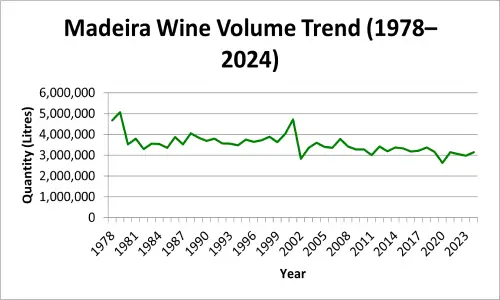
Summary analysis of the volume and value trend for Madeira wine (1978-2024)
| Metric | Value |
| Total Volume Change (Lt) | –1,536,421 |
| Total Value Change (€) | +19,422,976 |
| CAGR Volume (1978–2024) | –1.00% |
| CAGR Value (1978–2024) | +6.29% |
| CAGR Price/Litre (1978–2024) | +7.42% |
| Peak Volume Year | 2001 (4,707,425 L) |
| Peak Value Year | 2023 (€21,201,535) |
| Lowest Volume Year (post-1978) | 2020 (2,623,683 L), which was the Corona virus (COVID) pandemic |
Despite a 1% annual decline in volume, value grew 6.29% per year.
Price per litre rose from €0.30 in 1978 to €6.63 in 2024 — a 22× increase.
Volume & Value Trend for Madeira wine (1978–2024)[11]
1978
Quantity: 4,673,253 L
Value: €1,402,182
Price per Litre: €0.30
2001
Quantity: 4,707,425 L
Value: €18,650,968
Price per Litre: €3.96
2020
Quantity: 2,623,683 L
Value: €14,636,687
Price per Litre: €5.58
2024
Quantity: 3,136,832 L
Value: €20,825,158
Price per Litre: €6.63
While Madeira has undoubtedly lost volumes, but has been successful in increasing value which is very encouraging for the long term success of Madeira wine.
Port leads in both volume and price per litre, reflecting its strong global positioning and premium segments. Sherry still commercialises large volumes but at a lower price point, though it has seen steady price growth. Madeira has the highest price growth over time, despite lower volumes — a clear sign of premiumisation.
Fortified Wine Comparison – price per litre (Most Recent Years Available)
Madeira
Year: 2024
Volume: 3,136,832 Litres
Value: €20,825,158
Price per Litre: €6.64
Port
Year: 2025
Volume: 15,900,000 Litres
Value: €164,000,000
Price per Litre: €10.31
Sherry
Year: 2022
Volume: 27,000,000 Litres
Value: €150,000,000
Price per Litre: €5.56
What has happened to Sherry and Port wines?
Vineyard area in Jerez has fallen by 70% since the 1970s, a direct indicator of collapsing production and demand.[12] Worldwide Sherry sales dropped by 50% between 2004 and 2022 (Consejo Regulador).[13] The industry view is that the decline is irreversible and many growers are turning to table wines instead.[14] It is clearly seen in my experience that Sherry is no longer a Christmas staple in the UK as it was for so many years, with a noted decline particularly in the 1980s and 1990s.
Sherry cask production is important for Scotch whisky maturation, which could represent 6% to 15% of total Sherry production. While quite a low volume and having little impact upon the long term decline in Sherry production, this is believed to be a very profitable activity for the industry, but hard data is difficult to come by.
There is no public data on the sales of Madeira wine casks to the Scotch Whisky industry. Unlike Sherry producers who operate quite large scale seasoning operations, Madeira producers do not operate seasoning regimes specifically for the Scotch Whisky industry.
There is data that Sherry grape growers are planting varietals to meet the cask seasoning requirements of the Scotch whisky industry.[15]
Port sales have dropped by 25% between 2006 and 2021[16] It is possible to extrapolate a 40% to 50% decline in Port volumes from 1978 to 2024. Port appears to be losing volumes at the entry level of Ruby and Tawny port wines. This is similar to what is happening to Madeira wine, as we shall explore in future posts.
In summary
The data clearly shows that Madeira wine commercialisation has been in gentle decline after the precipitous drop 1978-2024. The CAGR decline at 1% is a creditable performance given the overall performance of the global wine market and against the performance of Sherry and Port wines. The growth in value is very positive and noteworthy in the context of premiumisation. Madeira has a bright future ahead, but not one without challenges.
[1] The Economist newspaper January 17th 2026
[2] IWSR – Global leader in beverage alcohol data and insights
[3] https://www.oiv.int/sites/default/files/documents/OIV_2025_World_Wine_Production
[4] The 2025 Wine Map: Global Production and Consumption at a glance — Wines Experience
[7] Commercialisation is the entire process of bringing wine to market and generating economic value from it. It’s not just selling the wine—it’s the strategic and operational work that ensures the wine reaches the right consumers, at the right price, in the right markets.
[9] Trevor Elliott (2010) The wines of Madeira (P25)
[10] There are more vineyards who choose to use their production for home consumption using non authorised wines (often refered to as Ameicano).
[11] Source: commercialisation-of-madeira-wine-1976—20246797b005971ad.pdf
[12] The world of fine wine- Is there a future for fortified wine?
[13] The world of fine wine- Is there a future for fortified wine?
[14] The Drinks Business – Sherry producers are starting to make table wine
[15] BoozeNetworks.com Sherry revival: Scotland’s Secret to Premium Whisky
[16] Global Drinks Intelligence- Port and Sherry’s perennial balancing act between old and new.